
There are films that dare you to tap out, and then there are films that dare you to stay open. Touch Me very firmly belongs to the latter category. Addison Heimann’s psychosexual sci-fi horror comedy is loud, horny, emotionally sincere, and deeply strange, and somehow all of those things coexist without the movie collapsing under the weight of its own ambition.

From the opening moments, it is clear Touch Me is operating on a heightened wavelength. The color grade is bright, saturated, and unapologetically stylized, bathing nearly every scene in neon hues and artificial warmth. It looks fantastic, even when it feels excessive, and often especially when it feels excessive. Heimann has no interest in subtlety. The film floods the frame with color, texture, and abrupt tonal shifts, and dares the audience to either get on board or quietly excuse themselves.
The premise is immediately bizarre and only grows more so. Two emotionally codependent friends, adrift and homeless after a run of bad luck, reconnect with a mysterious ex who happens to be an alien whose touch temporarily erases anxiety and depression. What starts as a weirdly sexy healing retreat quickly reveals itself to be something far darker, sliding into cult dynamics, addiction metaphors, and bodily horror soaked in sexual longing.

The film’s erotic energy is impossible to ignore and occasionally impossible to look away from. Bodies are front and center, sometimes to a distracting degree, and the camera lingers with deliberateness that will test some viewers’ comfort levels. Yet this hypersexual presentation never feels accidental. It is tied directly to the film’s larger obsessions with desire, validation, self-medicating intimacy, and the dangerous appeal of someone promising to make the pain disappear if you just give them enough of yourself.
Tonally, Touch Me walks a wild tightrope. It is funny, often very funny, with absurd comedic beats and knowingly outrageous moments that play like midnight movie dares. It is also deeply sad. Beneath the tentacles, fluids, and freakouts is an oddly emotional core about trauma recovery and the exhausting fantasy of being cured rather than learning how to live with brokenness. Heimann’s personal investment in these themes bleed through the genre trappings, giving the film a surprising amount of heart.

Olivia Taylor Dudley is the film’s undeniable center, and she is, quite frankly, a star here. She navigates extremes of vulnerability, mania, erotic pull, and emotional devastation with confidence and control, delivering monologues that are both technically impressive and genuinely affecting. Lou Taylor Pucci matches her intensity as the alien lover whose soothing presence masks something deeply predatory. Together, they sell both the seductive fantasy and the creeping horror of a relationship built on dependency rather than healing.
The supporting cast reinforces the film’s cultlike atmosphere, with performances that lean into heightened reality without tipping into parody. There is a strong Japanese cinema influence at work, particularly from the 60s and 70s genre experimentation, visible in the stylization, pacing, and tonal whiplash. Heimann borrows that fearless approach and filters it through contemporary queer horror aesthetics, resulting in something that feels deeply referential yet personal.
Not everything lands cleanly. The film’s commitment to excess can border on self-indulgence, and some visual and narrative choices may alienate viewers who are not fully willing to surrender to its frequency. Certain shocks feel more defiant than necessary, and the constant escalation can dilute impact as the film races toward its finale.
Still, it is difficult to deny the achievement here. Touch Me is a joyous night of tentacle love, sexual fluidity, addiction horror, and outrageous hilarity that somehow sustains a beating emotional heart underneath all the slime and synths. Whether read as a metaphor for abusive relationships, a satire of hookup culture, a queer meditation on mental illness, or simply an unhinged cosmic kink nightmare, it refuses to prescribe meaning while inviting interpretation.
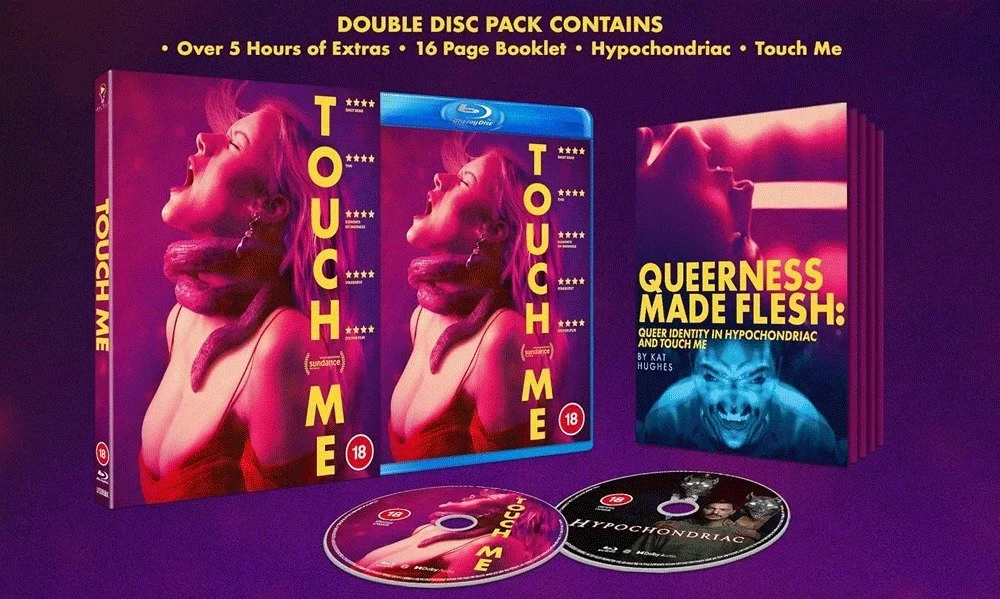
Set for release on Blu-ray and digital on 4th May, the limited edition Blu-ray includes Heimann’s debut feature Hypochondriac (2022) and an exclusive 16-page booklet “Queerness Made Flesh” written by horror critic and enthusiast Kat Hughes.
Jessie Hobson