
There is a particular kind of filmmaker who thrives on the impossible. The kind who sees a lack of money, crew, time, or infrastructure not as a limitation, but as an invitation. Polaris Banks has been that guy for a long time, and And Her Body Was Never Found feels like the most distilled version yet of everything he has been circling since Casey Jones splattered ninja mayhem across an alleyway over a decade ago.
This time, the challenge was extreme by design. Two people, deep in the wilderness. No crew. No safety net. A marriage under strain. Polaris Banks and Mor Cohen set out not just to make a microbudget feature, but to excavate something personal, volatile, and risky. As Banks joked during our SXSW conversation, making the film felt “like being on Iron Chef, but given shoelaces as ingredients.” And somehow, they turned those shoelaces into something sharp, funny, painful, and deeply watchable.
The premise of And Her Body Was Never Found is deceptively simple. A couple retreats into the woods to make a movie about their troubled relationship, only to find the lines between performance and reality collapsing. The reality behind that premise, though, was even more fraught. Banks explained that while many filmmakers attempt stripped-down two-handers, most of them fail. He had seen those attempts come across distribution desks again and again, and he knew how easily this could have gone wrong. “We were aware that we were out of money, out of favors, and out of resources,” he said. “So we had to use what we did have.”
What they had, uncomfortably, was conflict.

Banks described their fights with brutal honesty, talking about a spiral dynamic where “what triggers her triggers me, triggers her,” a feedback loop that could last for days. It was something they were ashamed of, something that weighed on them, but it also became the core creative engine of the film. In moments of dark humor, Banks admitted that during their worst arguments, part of his brain couldn’t help but notice how cinematically compelling Cohen’s expressions and delivery were. It was entertaining in a horrifying way, the kind of thing that would be unbearable in real life but magnetic if caught on camera.
That idea became the movie. And it became something even more dangerous when layered with the technical ambition of the shoot. Banks was adamant that this could not look like a half-baked experiment. They were hauling professional-level gear, shooting on an Alexa with serious lenses, doing the work of an entire crew between two people. The goal was to make something that would leave viewers asking how it was even possible. “We were trying to use the skills we built on Casey Jones and Reklaw,” he said, “and make something where the quality is almost confusing.”
For Cohen, the emotional toll was just as intense, if not more so. She spoke candidly about walking onto set in a place of deep fear and distrust. At the time of shooting, they were actively in couples therapy. Their therapist had warned them bluntly that going forward with the film could end their marriage. Two weeks before production, she told them flat out that if they did this, they might not come back a couple.
They did it anyway.

The result, paradoxically, was survival. As Cohen reflected, the film introduced real consequences into patterns that had previously been abstract. If they did not work together, the movie would not get made. If the movie fell apart, so might they. On one rain-delayed day in the middle of the shoot, they spent hours arguing in a laundromat, airing grievances about disrespect, control, and feeling sabotaged by the other. It was brutal, but it cracked something open. Cohen described realizing, maybe for the first time, what it meant for Banks to be directing not just against weather and logistics, but against her emotional volatility as well. The awareness was painful, but necessary.
By the end of the shoot, their relationship had fundamentally shifted. Cohen even said at the SXSW screening that they were not truly married until they made this movie. It taught them how to be a couple. Banks did not hesitate to give the film full credit for the fact that they are still together.
The aftermath of making And Her Body Was Never Found did not stop when production wrapped. Editing became another trial by fire. Banks handled the edit himself, often working until dawn for weeks straight. Cohen took on the task of creating the closed captions, which forced her to relive every line, every escalation, every ugly truth in intimate detail. She described having to take frequent breaks just to breathe, and at one point, collapsing into a full emotional release once she finally pushed through the hardest sections.
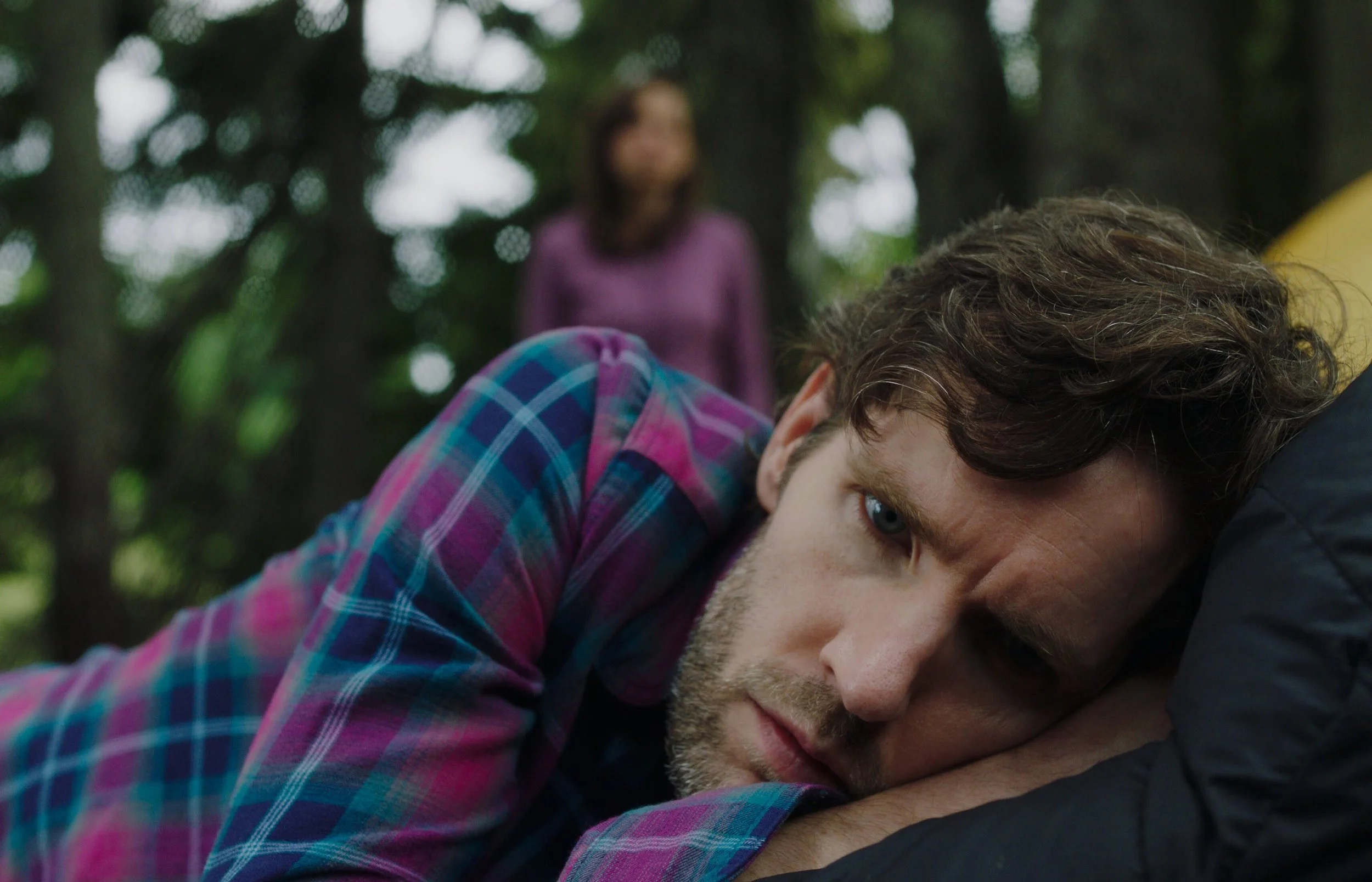
For Banks, the most painful material was not what ended up on screen. It was the real fights between takes, the discarded footage he relegated to a timeline for possible behind-the-scenes use. Watching their raw, unscripted bickering depressed him far more than the performative arguments in the film. The scripted scenes were lines. The unscripted moments were who they actually were in that period of their lives.
Writing the movie, though, was where Banks found empathy. He talked about the devastation of writing scenes from Cohen’s perspective, fully inhabiting her feelings, and emerging in tears, apologizing for what he had put her through. He approached the script almost like journalism, interviewing her about their arguments and motivations, trying to understand not just what she said, but why she said it. What she was protecting. What she was afraid of. Cohen had veto power, but what struck Banks most was how fair she was. She did not want to hide the ugliness. She only wanted balance.
The result is a film that does not let either party off the hook.
What makes And Her Body Was Never Found connect is that, despite its intensity, it is fun. That word comes up again and again, and Banks wears it as a badge of honor. He loves Hitchcock and Fincher not because they traumatize audiences, but because they do it while entertaining them. He wants viewers to have a blast, even as they recognize pieces of their own relationships reflected back at them.

Both Banks and Cohen emphasized that the heart of the film is letting audiences know they are not alone. That argument prison feeling, the sense that something must be fundamentally wrong with you or your relationship, is far more universal than people admit. The fights may be heightened here, but the dynamics are familiar. Communication breakdowns. Power struggles. Fear masquerading as control.
For filmmakers especially, there is another message running just beneath the surface. You do not need permission. You do not need money. You do not need a perfect scenario. You just need honesty and the willingness to do something risky. Banks was clear about that. If people look at Casey Jones or Reklaw and think the logistics are too daunting, this film is proof that there is always another way in. Sit down. Write something truthful. Make it entertaining. Use what you have. Or, as he put it with a laugh, if nothing else, make a movie.
Jessie Hobson