
From its opening moments, Heel plants you directly inside the kind of chaos that feels uncomfortably familiar. A reckless night out, alcohol blurring consequence, bravado curdling into danger. It is the sort of opener that does not romanticize self-destruction but stares it down long enough to remind you why it always ends badly. Once the trap snaps shut, the film never really lets you breathe.
The hook is deceptively simple. Tommy, a nineteen-year-old hooligan played with unnerving volatility by Anson Boon, is abducted after a night of excess and wakes up chained in the basement of a remote farmhouse. His captors are Chris, his wife Kathryn, and their teenage son Jonathan, a family unit so broken it feels like a warning label. Chris is portrayed by Stephen Graham, and it is impossible not to feel the weight he brings. Graham has built a career on raw menace and bruised humanity, and here he weaponizes both. This is a different shade of his usual intensity, quieter, creepier, and all the more terrifying for it.

What follows is not a traditional survival thriller. The horror in Heel is less about physical brutality and more about psychological erosion. Chris does not simply imprison Tommy; he attempts to fix him. Therapy sessions become torture, discipline masquerades as care, and rehabilitation slides into delusion. Videos of Tommy’s past behavior are replayed like courtroom evidence, while warped public service style lectures drip with dark comedy and cruelty. It is funny in a way that makes you immediately uncomfortable for laughing.
Jan Komasa directs the film with a tight, suffocating control that keeps curiosity high even when the scenario grows grim. The story constantly invites you to ask why, what next, and how far this will go. That sense of mystery is one of the film’s strongest assets. You stay locked in, edge of your seat, no bathroom breaks, because every scene feels like it might tip the balance in an unexpected direction.

The performances do the heavy lifting, and they are uniformly excellent. Graham’s Chris believes fully in his own moral authority, convinced that coercion is compassion and violence is love if it produces results. Andrea Riseborough plays Kathryn with a fractured stillness that is deeply unsettling. Her broken demeanor suggests someone who has already surrendered to the house’s warped logic, making her softness feel just as dangerous as Chris’s rage. Boon’s transformation is the most striking. Tommy shifts from menacing loudmouth to subdued survivor without ever becoming innocent or easy to sympathize with. You despise him for his past and ache for him in the present, often at the same time.
One of the film’s most cutting moments comes not from the basement but from a brief exchange between a detective and Tommy’s mother. In a few cruel lines, the film exposes the neglect that shaped him. Suddenly, the twisted care offered by his captors feels more attentive than anything he has known before. That idea is where Heel becomes truly disturbing. Komasa frames captivity as both prison and sanctuary, suggesting that attention, even when warped, can be more powerful than freedom abandoned by neglect.
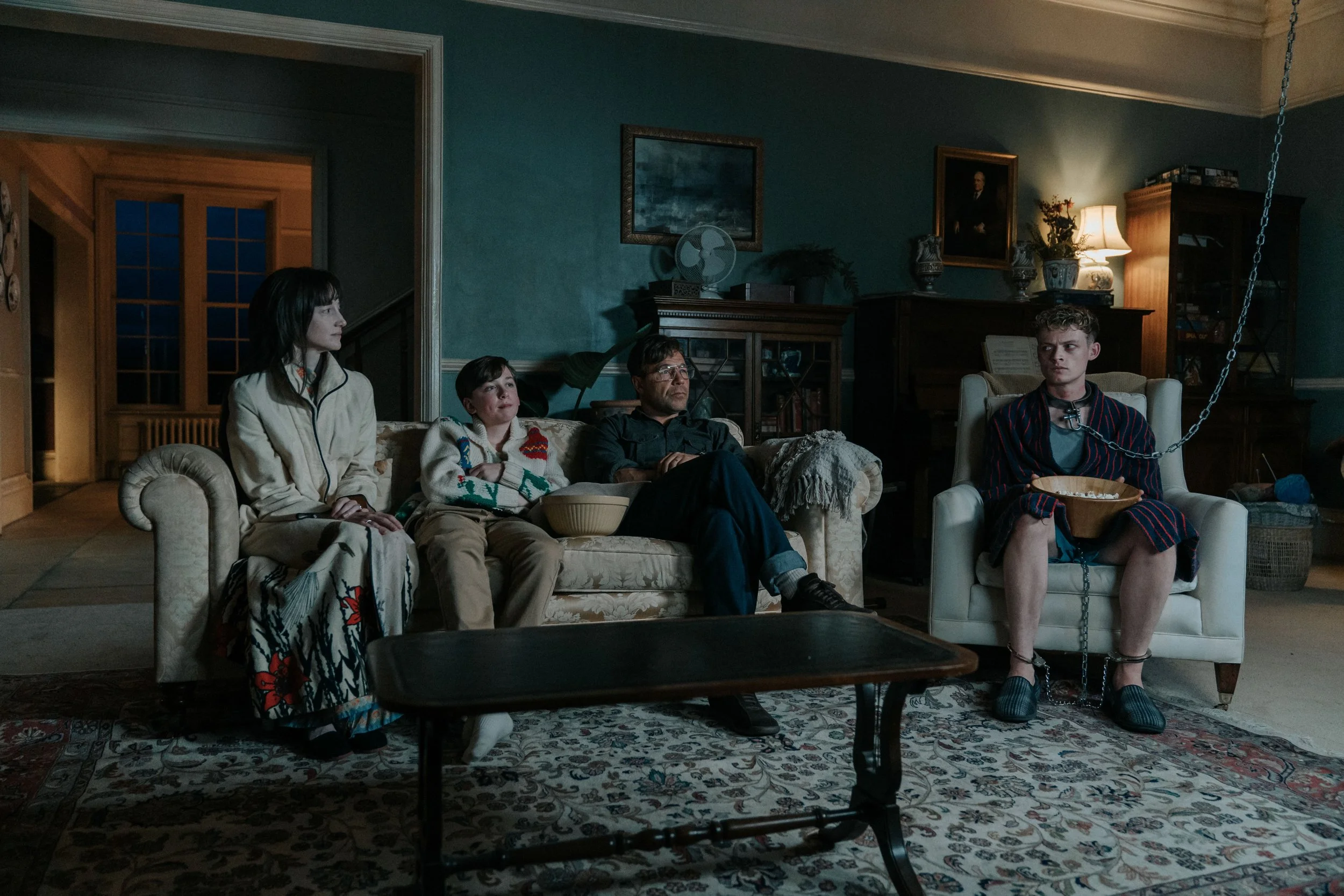
Visually, the film is cold and controlled, turning domestic spaces into psychological traps. The basement becomes a warped womb, a place of punishment and rebirth that feels horrifyingly plausible. There is a European restraint to the filmmaking that resists easy catharsis, leaning instead into moral ambiguity and lingering discomfort.
That said, the film is not without its flaws. The ending lands with an oddly annoying sense of finality that feels unearned for characters who thrive in moral grayness. Rather than deepening the film’s questions, the conclusion slightly undercuts them, offering resolution where unease might have been more honest.
Still, Heel is an impressively original bottle film. Darkly comic, deeply unnerving, and anchored by three powerhouse performances, it stays interesting throughout and never loses its grip. It asks whether change born from coercion can ever be real, and whether a monster created by neglect can be undone by twisted care. The answers are murky, and that is precisely the point.
Jessie Hobson