
Gregory Hatanaka’s Sorority House Guillotine is less a traditional horror film and more a drifting psychological experience, a mood piece that plays with presence and absence in ways that feel strangely hypnotic. Set almost entirely within a Los Angeles sorority house, the film explores the lives, conversations, and emotional undercurrents of a group of young women who move through the night as if suspended in time. Nothing in this world is rushed. Nothing is spelled out. Meaning arrives gradually, like condensation forming on glass.
The masked figure who roams the periphery—a role performed with eerie stillness by Jamie Grefe—isn’t a slasher villain looking for a body count. He is a presence, almost a theory of violence more than an actor in it. The film’s sense of dread grows not from jump scares but from repetition, drifting dialogue, and the way unspoken tension hums underneath scenes that appear harmless at first glance.
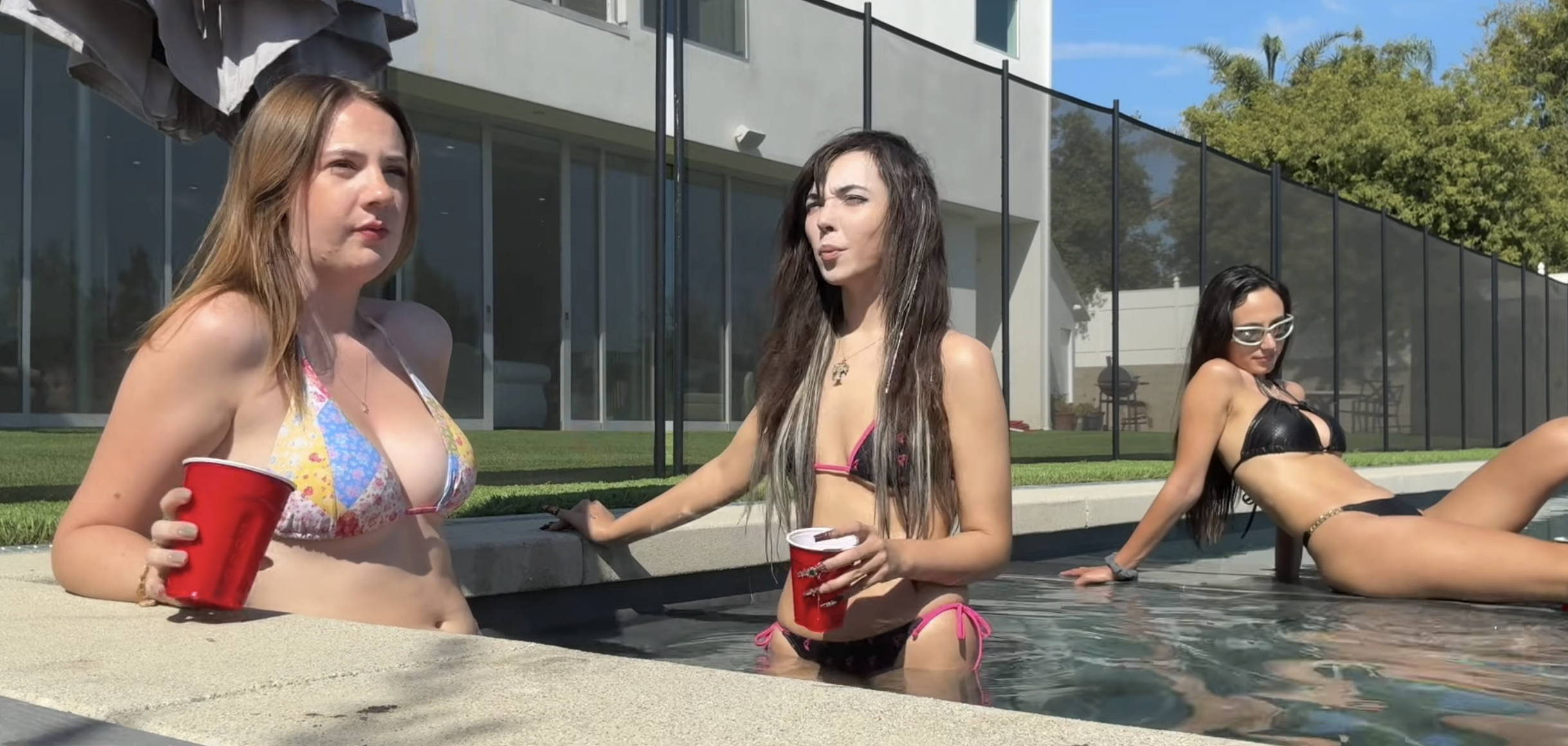
Much of the film’s structure is built from overlapping conversations among the women, played with naturalistic ease by Briana Rowe, Julia Burenok, Christina Fielding, Kristine Thompson, and Bryan Brewer. The dialogue often feels improvised, and intentionally so. The women float from topic to topic—friendships, futures, stray memories, old cinema, sound, boredom, intimacy—never fully settling anywhere. Their conversations move like water in the pool beside them: shimmering, changing direction, occasionally catching light in a way that hints at something deeper.

The film leans into that looseness. Instead of guiding viewers through a plotted escalation, it invites them to listen. To notice tone. To sit with drift. The narration, poetic and introspective, becomes the spine of the experience. It speaks to loneliness, repetition, emotional erosion, and the feeling of living slightly outside one’s own life. It reflects on art, music, memory, old films, lost endings, and the strange ways meaning appears and dissolves.
What makes Sorority House Guillotine unsettling is how honest it is about dread. Not fear. Dread. Fear reacts. Dread anticipates. The film watches social interactions with the curiosity of someone studying human behavior from a distance. It recognizes how people perform themselves, how connection grows thin even when everyone seems happy, how silence is never empty but full of pressure.
The sense of danger comes from the possibility that something is happening just out of sight. Something inevitable. Something that has been moving toward these characters long before they ever noticed it.
When the masked man finally edges closer to the center of the frame, it feels less like an intrusion and more like an event the film has been quietly orbiting. Not a twist. Not a payoff. A recognition.

Louis DeStefano’s cinematography supports the film’s rhythmic looseness with a soft visual patience. Shots linger. Movements stretch. Lights shimmer across the surface of the pool like memories trying to stay intact. The entire house feels suspended, as if time is working differently here.
The film’s relationship to sound is equally deliberate. Music drifts in and out. Voices overlap. Silence weighs the air. The film often feels like an essay told through audio, with visual elements serving as atmosphere rather than exposition.
This is where Hatanaka’s signature emerges. The movie balances improvisation with precise emotional construction. It might feel loose, but nothing is careless. The structure is hidden but present, the way a melody holds together a piece of jazz, even when the notes seem to wander.
Sorority House Guillotine resists familiar genre expectations. It is not interested in tidy arcs or cathartic resolutions. It is preoccupied with drift, with sensory accumulation, with the experience of being in a space where something is off but never loudly wrong.
This is what makes it compelling. It asks you to sit inside the atmosphere rather than chase the plot. It invites you to listen more than watch. It rewards attention but refuses to explain itself.
By the time the film reaches its strangest and most surreal musical imagery near the end, it feels less like a climax and more like a fever dream finally breaking through the surface of the night.
Sorority House Guillotine is a work of mood and emotional texture, an experiment that blends freeform improvisation with cinematic meditation. It is a horror film by category but an essay film in spirit, and for viewers willing to let go of narrative expectations, it offers something rare: a chance to feel dread as an atmosphere, not an event.
It is, in many ways, peak Hatanaka. Creative, referential, patient, hypnotic. A film that lingers. A film that waits. A film that recognizes that sometimes the scariest moments are the quiet ones where you sense something shifting beneath the surface.
Jessie Hobson